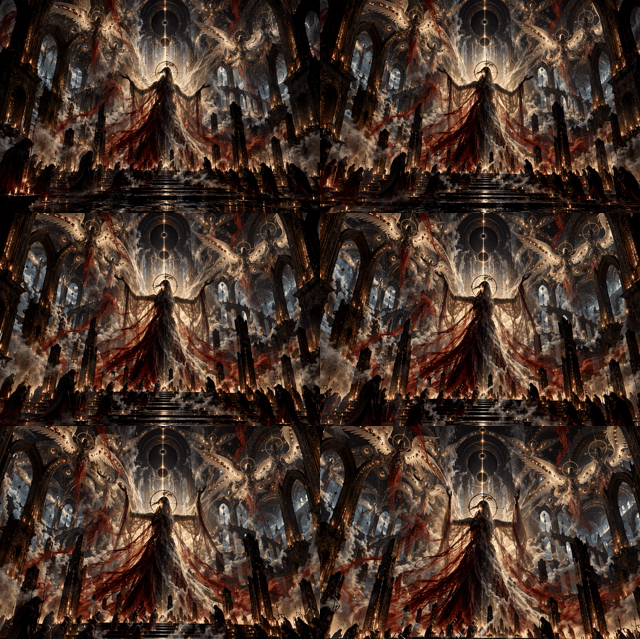
You know, amid all the spooky, haunted fun of Halloween, we remain vaguely aware of our own cosmic insignificance. Of the things in this universe we’re simply never meant to understand. Things beyond our perception, beyond our comprehension, beyond the endless layers of reality that imprison our conscious minds.
And sometimes, if we’re fortunate, or perhaps terribly unfortunate, we can somehow hear them.
Which brings us to today’s installment of Buttkickin’ Halloween Songs, The Host of Seraphim by Dead Can Dance. A standout track from their 1988 album The Serpent’s Egg, it’s one of the most beautiful, haunting, and profoundly unsettling pieces of music I’ve ever encountered.
The composition opens with a low, droning organ and distant, funereal percussion, creating an ethereal soundscape where medieval European sacred music meets Middle Eastern influences. It feels like the opening of some ancient occult ceremony, but that’s about as far as our minds can perceive. Are we summoning an unspeakable evil from the darkest corners of Hell, or desperately attempting to prevent its release?
Yes.
And then there’s vocalist and composer Lisa Gerrard. Her magnificent contralto erupts like a wild, tortured violin, devastating us with wails of grief, terror, ecstasy, and transcendence. All without a single conventional lyric. Her voice sounds simultaneously intensely powerful and immeasurably broken, communicating emotions that language itself seems incapable of expressing.
But the real, inexplicable horror of this song boils down to one question: What exactly are we hearing?
The titular seraphim are traditionally among the highest orders of angels, closest to the Divine. Are these celestial guardians protecting us from some infernal incursion? Or fallen creatures themselves, former angels damned into demonic beings, summoned from an unimaginable abyss?
I haven’t the slightest idea. And maybe I don’t want to know. Because the song’s greatest strength is its ability to reach into our collective unconscious and awaken emotions we cannot possibly quantify.
Longing. Mourning. Ecstasy. Worship. Horror. Desire. But directed toward whom… or what? And more importantly, why does it all feel so terribly familiar?
Listening to The Host of Seraphim offers a revelation we can never fully comprehend. It reminds us that we’re shackled within dungeons of human perception, barely able to hear cosmic entities wailing somewhere beyond our prison walls. Their cries awaken something buried within us, something instantly recognizable yet forever beyond our understanding.
Perhaps that’s the great irony of being lowly fourth-dimensional ants. Our greatest agony, and simultaneously our most extraordinary gift, is the ability to feel within our souls that which our minds cannot possibly transcribe.
And perhaps the greatest horror is that even in the presence of the Divine, the highest angels themselves still weep. In fear, terror, awe, and love. All at once.
For an additional dose of contemporary horror, Frank Darabont employed this extraordinary composition during the devastating conclusion of his 2007 adaptation of Stephen King’s The Mist. I won’t spoil it here, but if you know, YOU KNOW. Anguish personified, indeed.
Ultimately, The Host of Seraphim makes no attempt to distinguish between the beauty and horror of the unknown. Is it a lamentation for the dead? The ecstasy of divine worship? The horror of demonic possession? The final cries of humanity witnessing its apocalyptic annihilation?
Yes.
The terrifying beauty of these contradictions forms the very foundation of existential dread. And somewhere beyond the prison walls of our limited perception, incomprehensible beings are still wailing.
We may never understand why. But Gods help us, we can feel it.


